

Super User
Seed Soak

Seed Soak's active ingredient is our organic Bamboo Wood Vinegar (also known as Pyroligneous acid or Liquid Smoke). It is the condensed liquid caputured during pyrolysis during Biochar production. It contains more than 200 organic elements and plant like compounds, which work synergistically to make plants stronger, leaves greener and stimulates microbial growth.
How it works:
Treating seeds by soaking in Seed Soak helps penetrate the outer coating that is protecting the future plant inside and accelerates growth.
Seed Soak is absorbed into the intact seed coat. With proper conditions (moisture, temperature, light) the seed coat will then start to swell and rupture, thereby releasing its food stores and germination and growth begins. By using Seed Soak ahead of time, you remove many of the barriers to germination, so that the seeds are ready to sprout by the time you plant them. This can be particularly useful for gardeners with heavy clay or super sandy soil as it helps provide the right level of moisture to start growth. It also reduces the stress of ensuring your soil is adequately damp after you’ve sowed a row of seeds.
In general, the bigger and tougher the seed, the better it will fare using Seed Soak.
Benefits include:
- Higher germination success rate
- Faster germination results, in as little as 3 days
- Accelerated leaf growth by up to 30%
- Increased number of leaves per plant, therefore leaf area and improved photosynthetic capacity
- Better root development which contributes to a better plant development and earlier harvests
- Allows seed stock to be stored for longer periods and older seeds to be used
- Less soil preparation
- Used as foliar spray it can promote plant growth and increase resilience to pests and diseases
Application Rates
Soil sterilisation: Diluted with clean water at the ratio of 1: 50-100, sprayed to the soil.
Reducing insect infestation: Diluted with clean water at the ratio of 1: 300-500, foliar spray or root irrigation.
Seedlings: Diluted with clean water at the ratio of 1: 800-1000, foliar spray or root irrigation (first applied at 2ndleaf stage) at intervals of 15 days
Growing and mature plants: Diluted with clean water at the ratio of 1: 500-700, foliar spray or root irrigation at intervals of 15 days
Enriching the soil: Dilute wood vinegar with water ( 1:200 ration-1 part wood vinegar and 200 part water) and sprinkle it to the soil before planting. Application is one liter solution for every square meter of planting area.
Applying to compost: Dilute one part wood vinegar with 50 parts water and sprinkle to composting materials. Application rate is 50 liters solution to one compost.
Fertilisation: Dilute one part wood vinegar with 200 parts water and spray it to leaves once a month. Dilution ratio can be change to 300 parts water for the succeeding applications.
 Seed germination: Dilute one part wood vinegar with 200 parts water then soak the seeds for 24 hours.
Pest repellent or deodoriser: Dilute one part vinegar with 20 parts water and spray it it the plant or to the substrate in case of odor removal.
The Appropriate Technology Association of Thailand recommends the following wood vinegar/water solution rates for various farm uses (ATA, p. 27-28). Note that, in some cases, no details were given regarding the specific identity of pests.
Repel nematodes: Tomatoes, 1:500 (apply to the base of plants); strawberries, 1:200 (apply to the base of plants); and black pepper vines, 1:1500 (apply in place of water).
Repel insect pests: Cabbage and Chinese cabbage, 1:1500 (apply in place of water); corn 1:300 (spray onto leaves).
Control of fungal diseases: Tomato and cucumber, 1:200 (spray onto leaves).
Control of root rot: Tomato and cucumber, 1:200 (apply to the base of plants).
Reduce incidence of chili pepper flowers aborting: 1:300 (spray onto leaves).
Improve flavor of sweet fruits and stimulate development of crops: Mix solution rates of 1:500 to 1:1000. Wood vinegar prevents excessive nitrogen levels, improves plant metabolism and contributes to higher fruit sugar levels.
Stimulate compost production: A solution rate of 1:100 will help increase the biological activity of various beneficial microbes and can decrease composting times.
Combat bad odour: A wood vinegar solution of 1:50 will diminish the production of odor-causing ammonia in animal pens.
Supplement for livestock feed: Mixed with livestock feed at rates of between 1:200 and 1:300, wood vinegar can adjust bacterial levels in the animal digestive tract which improve the absorption of nutrients from feed.
Enrich garden soil: Use a strong solution of 1:30 to apply to the garden soil surface at a rate of 6 liters of solution per 1m to enrich the soil prior to planting crops.
To control soil-based plant pathogens: Use an even stronger rate of 1:5 to 1:10.
Repel houseflies: Dilute wood vinegar at a rate of 1:100 and apply to affected areas.
Notes:
Must not be used with alkaline pesticides and must not be used during crops flowering stage.
If it rains within 12 hours after application the application may need to be repeated once the plants have dried off.
Water Retention
Biochar is a desirable soil material in many locations due to its ability to attract and retain water.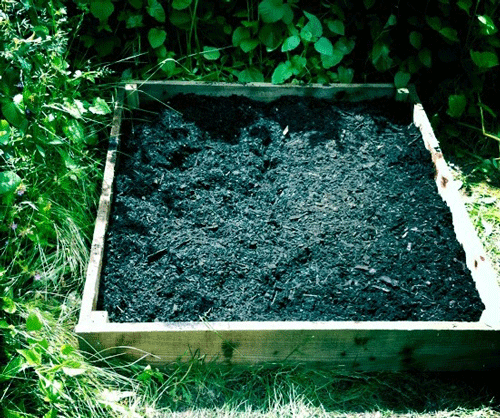

This is possible because of its porous structure and high surface area. As a result, nutrients, phosphorus, and agrochemicals are retained for the plants benefit. Plants therefore, are healthier and fertilizers leach less into surface or groundwater.
Soil Amendment
Biochar is recognised as offering a number of benefits for soil health. Many benefits are related to the extremely porous nature of biochar. 
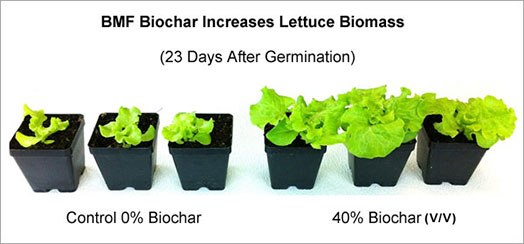
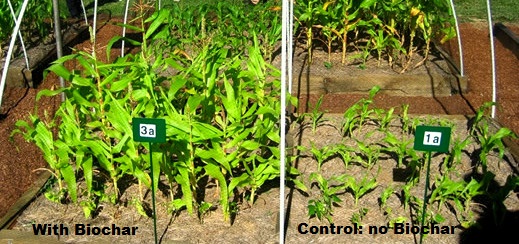
This structure is found to be very effective at retaining both water and water-soluble nutrients. Soil biologists recognises the extreme suitability of biochar as a habitat for many beneficial soil micro organisms. When pre charged with these beneficial organisms biochar becomes an extremely effective soil amendment promoting good soil, and in turn plant, health.
For plants that require high potash and elevated pH, biochar can be used as a soil amendment to improve yield. Biochar can improve water quality, reduce soil emissions of greenhouse gases, reduce nutrient leaching, reduce soil acidity, and reduce irrigation and fertilizer requirements.Biochar was also found under certain circumstances to induce plant systemic responses to foliar fungal diseases and to improve plant responses to diseases caused by soilborne pathogens.
The various impacts of biochar can be dependent on the properties of the biochar, as well as the amount applied, and there is still a lack of knowledge about the important mechanisms and properties. Biochar impact may depend on regional conditions including soil type, soil condition (depleted or healthy), temperature, and humidity. Modest additions of biochar to soil reduce nitrous oxide N2O emissions by up to 80% and eliminate methane emissions, which are both more potent greenhouse gases than CO2.
Pollutants such as metals and pesticides seep into soil and contaminate food supplies, reducing the amount of land suitable for agricultural production. Studies have reported positive effects from biochar on crop production in degraded and nutrient–poor soils. Biochar can be designed with specific qualities to target distinct properties of soils. Biochar reduces leaching of critical nutrients, creates a higher crop uptake of nutrients, and provides greater soil availability of nutrients. At 10% levels biochar reduced contaminant levels in plants by up to 80%, while reducing total chlordane and DDX content in the plants by 68 and 79%, respectively. On the other hand, because of its high adsorption capacity, biochar may reduce the efficacy of soil applied pesticides that are needed for weed and pest control. High-surface-area biochars may be particularly problematic in this regard; more research into the long-term effects of biochar addition to soil is needed.
Where to buy

FAQ's
How much Biochar do I need?
This is the subject of ongoing studies. The degree of benefit clearly increases with the application rate. 
If you are satisfied with a very rough estimate, we would venture that a target application rate of 5 kg/cbm would be sufficient to achieve these results in most gardens. However, there are substantial benefits related to soil biology at rates well below 1 kg/cbm. For adding with other soil mixes we recommend a blend of 5 - 10%. This FAQ includes information on how to use small amounts of biochar in your garden to best advantage.
How long until I see the benefits?
Some effects, such as lowering soil acidity, occur immediately. Other effects depend on soil biology and take time to develop. Increased cation exchange capacity will take a few years to develop fully. The good news is that these effects are very persistent.
How much improved plant growth can I expect?
You can expect that harvested weight will be, in most cases, observeably higher with a combination of char+fertilizer than you will achieve with the same amount of fertilizer alone. In some cases, the observed effect will be dramatic. Steiner (2007) reported a doubling of maize grain yield with fertilizer+char compared to fertilizer alone. Yields subsequently declined over the course of four cropping cycles, however, the decline was less with char than with without. Significantly, soil P, K, Ca, Mg remained higher in the char amended soil despite greater harvest removal.
 What properties are important to the home gardener?
One of the most important quality of charcoal to the gardener is the ability to lower acidity. This is easily measured in an agricultural laboratory as calcium carbonate equivalent (CCE). Raising soil pH has been identified as biochar's most important contribution to influencing soil quality in the context of Terra Preta.
Does charcoal break down in the soil?
Charcoal is highly stable, however soil microbes do break it down, although at a very slow rate.
What is Pyrolysis?
Pyrolysis is the chemical decomposition of organic materials by heating in the absence of oxygen. This yields combustible gases (called syngas), tars and charcoal. The charcoal produced is a combination of black carbon, along with small amounts of bio-oil condensates, tars and ash.
Does Biochar affect soil pH?
Raising soil pH is biochar's most important contribution to influencing soil quality. Soil pH mostly influences the relative availability of nutrients. At low pH, aluminum toxicity is particularly harmful to plant growth. Aluminum toxicity is an extensive and severe soil problem and biochar is the most available and obvious solution that we have to combat it. Soil phosphorus availability is highly dependent on soil pH range, and thus biochar can be used to substantially increase phosphorus availability in soils that are below the ideal pH range of 6.5 to 7.0
Does Biochar affect soil biology?
The structure of the charcoal provide a refuge for small beneficial soil organisms from large grazers like earthworms. Charcoal increases activity by mycorhizal fungi. The presence of bio-char in soils actively promotes the formation of aggregates through a greater abundance of fungal hyphae. Bio-char is able to serve as a habitat for extraradical fungal hyphae that sporulate in their micropores due to lower competition from saprophytes.
How much carbon dioxide does sequestered Biochar offset?
The production of the charcoal itself has no carbon footprint assuming the fuel used to make the charcoal was diverted from fate of decomposition.
How much Nitrous Oxide formation does Biochar prevent?
Soil scientist Lucas Van Zweiten has observed a 5 to 10 fold reduction in nitrous oxide emmissions with biochars he is working with in an agricultural setting. Generally, soil with elevated soil nitrate levels in the presence of sufficient moisture and robust soil organic matter will have higher nitrous oxide production, and thus will be more likely to benefit at the levels observed by Van Zweiten.
What is the difference between Charcoal and Biochar?
Biochar and charcoal are technically two different things. The definition of Biochar (according to the International Biochar Initiative) is "a solid material obtained from the thermochemical conversion of biomass in an oxygen-limited environment." They go on to say that, “biochar can be used as a product itself or as an ingredient within a blended product, with a range of applications as an agent for soil improvement, improved resource use efficiency, remediation and/or protection against particular environmental pollution, and as an avenue for greenhouse gas (GHG) mitigation.” Charcoal is defined as "a dark or black porous carbon prepared from vegetable or animal substances (as from wood by charring in a kiln from which air is excluded)". Vegetable or animal substances.
In order to be called Biochar, it must be suitable for use in soil. Commercial charcoal is not going to necessarily be good for use in soil. Some of it may be. Some of it may not be. Many commercial charcoals are petroleum-based.
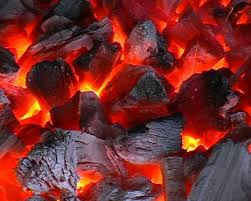 Biochar is sustainable produced, which means that it comes from waste biomass, or sustainably harvested biomass. Charcoal production is classically an unsustainable trade, and one of the biggest drivers of deforestation, particularly in developing countries.
A charcoal product is going to be optimized for its energy value. This means that factors such as fixed versus labile carbon are going to effect is market value differently than for Biochar. A high quality Biochar product should have a high fixed carbon content (meaning it will stay in the soil for a long time), minimal tars and a high surface area (giving lots of space for those little microbes).
What is the difference between Activated Charcoal and Biochar?
Activated Carbon, is dense charcoal that has been "activated" typically via a steam process or a chemical process (rather expensive). Activated charcoal is refined at higher temperatures, or acid washed to increase total surface area of the char. This drives out the volatile material (VM) fractions; tars, oils and other pyrolitic compounds.You use activated charcoal in applications where you a lot of filtration in a small space and/or the ph of the natural charcoal is a problem.
.
Natural Organic Liquid Fertiliser
BBPNo.12 
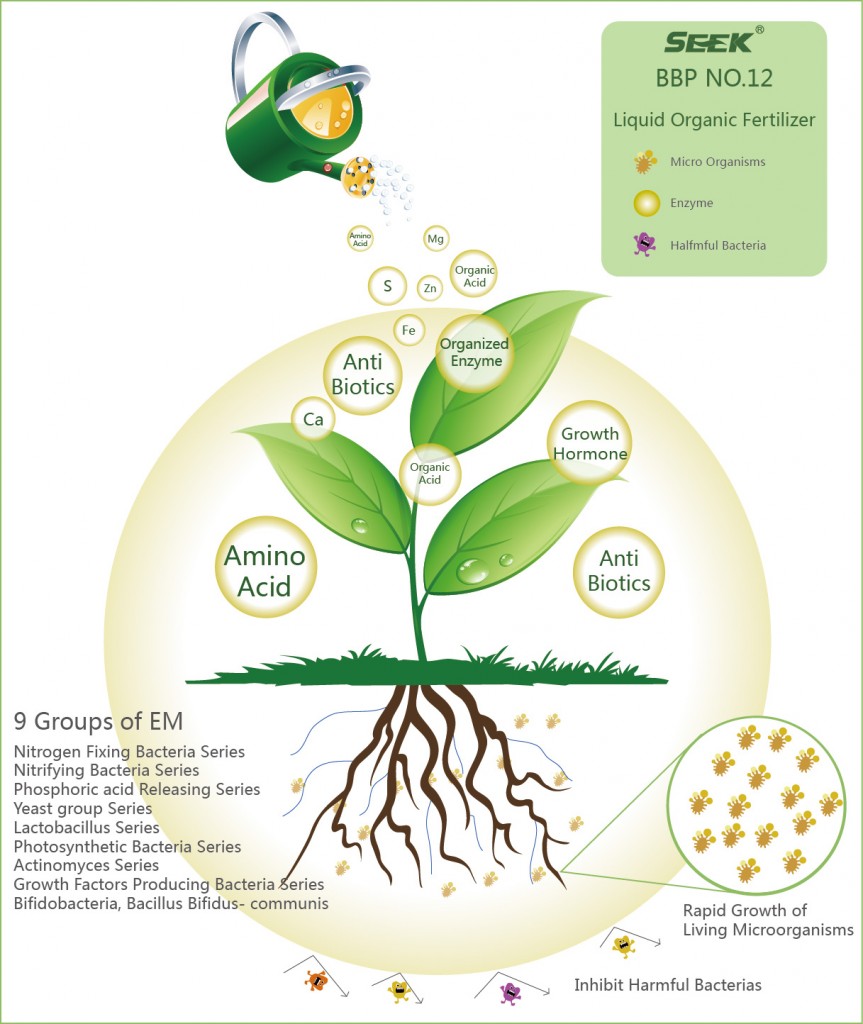
Natural Organic Liquid is a microbial fertiliser is based on special fermentation technologies, useful for all horticultural applications and crops including vegetables, fruits and flowers. The major components include live mico-organisms, ocean fish essences and other organic components. It is rich in nitrogen, phosphorus, potassium, active organic organisms, micro-nutrients and natural growth enzymes.
Benefits
- Ameliorates soil and extends soil fertility.
 Click to enlarge
 - Effectively solubilizes base fertilizers and reduces the effects of salt in the soil.
- Neutralizes the pH of soil and reduces continuous cropping obstacles.
- Reduces insect infestation and reduces the need for pesticides.
- Quickly activates plant immune systems and enhances decease resistance.
- Significantly inhibits root rot and strengthens root systems.
- Makes soil nutrients more available to plants and promotes symbiotic nitrogen fixation.
- Multiple nutrient sources and micro-nutrients increase crop yields.
Application
Foliar spray: Dilute at ratios of 1:300-500, depedning on plant variety and growth period. Spray the diluted product until the leaves are wet, but there are no drops falling off the plants. Apply every 10-15 days or up to a maximum of 5 times during the whole growth period.
Root Irrigation: Dilute at 1:200-300 per application.

Specification
|
NPK |
≥7% |
|
Organic matters |
≥15% |
|
pH |
6.0-8.0 |
|
Micro-nutrients |
≥2g/L |
|
Beneficial soil organisms |
≥5000 cfu/g |
|
Appearance |
brown |
Notes:
This product can be used in conjunction with pesticides. First dilute as per application rates before adding to the pesticides and thoroughly mixing the blend.
The best time for leaf application is morning and evening. Keep soil wet before spraying.
Stored in a cool and dry place, BBP No.12 is stable for 2 years.
Wood Vinegar

Organic Wood Vinegar is a reddish-brown liquid, obtained by condensing the water volatile organics, released during wood pyrolysis. Wood Vinegar is made up of about 89% water and numerous organic components, including organic acids, phenols, ketones, aldehydes, alcohols etc. Wood vinegar liquid is widely used in organic farming, horticulture, forestry, florists, animal husbandry and human medical care.
Biogro certified as an organic input.
Benefits
- Partially sterilizes the soil and reduces bacterial, fungal and insect pest infestations
Click to enlarge - Promotes the reproduction of beneficial micro-organisms, controls nematodes and other pests
- Acts as a synergist and dramatically reduces the need for other, more toxic pesticides
- Increases the photosynthetic capacity of plants and promotes plant growth
- Promotes fruits bud formation
- Improved seed germination strike rate (when pre-soaked)
- Allows better uptake and reduction in the use of fertilisers, herbicides and pesticides
- Stimulate compost production

BioChar Bio-Organic Granules
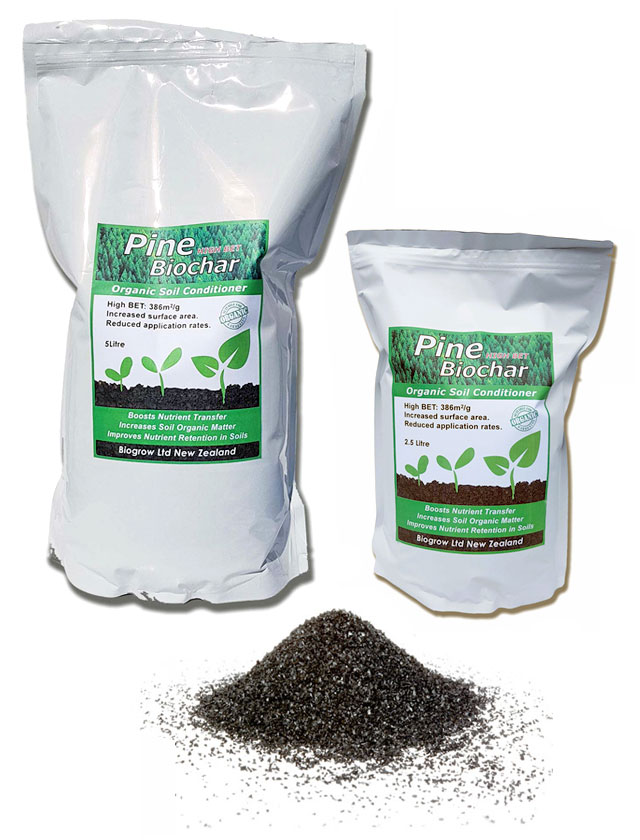
Pine Biochar (High BET) is a organic soil conditioner with a very high BET (surface area) of 386m²/g. BET is a commonly used standard for measuring surface area of solids.
The higher BET increases the available micro-pores in Pine Biochar which significantly increases the surface area and reduces the application rate compared to standard biochar by 50%.
This offers several key improved benefits, including:
- Reduces application rates compared to nornal Biochars.
- Allows for an increase in the availability and retention of nutrients in the soil for soil microbes to exchange with the plants roots.
- Helps repair damaged soils by encouraging soil microbe population growth and resultant organic matter.
- Aids in improved plant growth.
Application rates vary depending on soil quality, irrigation, etc:
- 500-750 litres per hectare for good to average soils
- 1000 – 1500 litres per hectare for average to poor soils.
- For smaller areas 2.5 litres biochar per cubic metre of soil. Ideally the biochar should be dug in or furrowed.

Apply preferred organic matter to charge the biochar at the same time.
Pine Biochar (HIGH BET) is made in New Zealand to biogrow’s specification and is available in various sizes, including bulk 1000 litre bags.
Biochar History
The technique of using charcoal to improve the fertility of soils originated in the Amazon basin at least 2500 years ago. The native Indians of the region would create charcoal and incorporate it in small plots of land from 1 - 80 hectares in size. Terra Preta, as it is known in this area of Brazil, remains highly fertile until today, even with little or no application of fertilizers. And this is in a region of the world known for its highly infertile soils.
Ancient Sites
Terra Preta sites have been found mainly along the major rivers of the Amazon basin. 
These prehistorically modified soils of central Amazonia have been called a model for sustainable agriculture in the twenty-first century. The pictures show a section of soil 1 meter deep comparing Terra Preta on the right, with nearby Oxisol on the left of the type that is normally found in the Amazon basin.
Black is the New Green
The following is an extract from an article Black is the New Green (published in Nature Magazine). A full copy of this article can be downloaded here.
"The soil scientists, archaeologists, geographers, agronomists, and anthropologists who study terra preta now agree that the Amazon’s dark earths, terra preta do índio, were made by the river basin’s original human residents, who were much more numerous than formerly supposed. The darkest patches correspond to the middens of settlements and are cluttered with crescents of broken pottery. The larger patches were once agricultural areas that the farmers enriched with charred trash of all sorts. Some soils are thought to be 7,000 years old. Compared with the surrounding soil, terra preta can contain three times as much phosphorus and nitrogen. And as its colour indicates, it contains far more carbon. In samples taken in Brazil by William Woods, an expert in abandoned settlements at the University of Kansas in Lawrence, the terra preta was up to 9% carbon, compared with 0.5% for plain soil from places nearby. From Smith’s time onwards, the sparse scholarly discussion of terra preta was focused mainly on the question of whether ‘savages’ could have been so clever as to enhance their land’s fertility.
Since then trial after trial with crop after crop has shown how remarkably fertile the terra preta is. Bruno Glaser, of the University of Bayreuth, Germany, a sometime collaborator of Sombroek’s, estimates that productivity of crops in terra preta is twice that of crops grown in nearby soils. But it is easier to measure the effect than explain it through detailed analysis. Everyone agrees that the explanation lies in large part with the char (or biochar) that gives the soil its darkness. This char is made when organic matter smoulders in an oxygen-poor environment, rather than burns. The particles of char produced this way are somehow able to gather up nutrients and water that might otherwise be washed down below the reach of roots. They become homes for populations of microorganisms that turn the soil into that spongy, fragrant, dark material that gardeners everywhere love to plunge their hands into.  Wim Sombroek championed the study of the Amazon's dark soils.
Leaving aside the subtleties of how char particles improve fertility, the sheer amount of carbon they can stash away is phenomenal. In 1992, Sombroek published his first work on the potential of terra preta as a tool for carbon sequestration. According to Glaser’s research, a hectare of metre-deep terra preta can contain 250 tonnes of carbon, as opposed to 100 tonnes in unimproved soils from similar parent material. The extra carbon is not just in the char — it’s also in the organic carbon and enhanced bacterial biomass that the char sustains."